The Crimson Wonder: A Deep Dive into Cuprite Rarity and Market Value
The emergence of cuprite as a facet-able gemstone represents one of the most remarkable developments in modern gemology, shifting the mineral’s status from a primary ore of copper to a pinnacle of collector interest. While cuprite has been utilized in industrial and decorative capacities for millennia, the existence of gem-quality crystals transparent and large enough to yield faceted stones over a few carats was long considered a geological impossibility. Specimens reaching substantial weights, such as 52 carats, exist within a tier of rarity that rivals famous colored diamonds and historical rubies.
Mineralogical Foundation and Chemical Composition
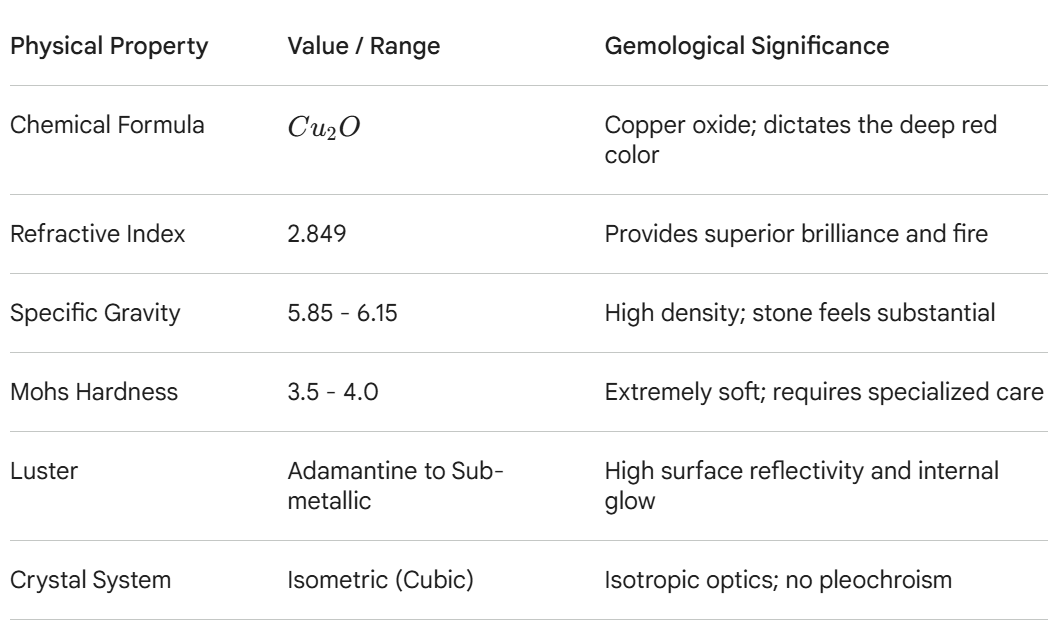
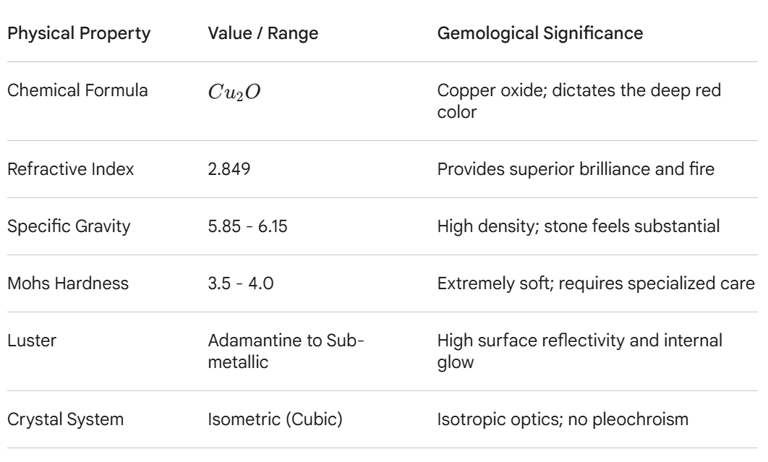
Cuprite is a simple oxide of copper, chemically identified as Cu2O. It crystallizes in the isometric (cubic) system, typically occurring in octahedral, cubic, or dodecahedral habits. As a secondary mineral, it forms in the weathered zones of copper deposits where primary minerals are exposed to oxygenated groundwater. This secondary origin is crucial to its rarity; the environment of formation is usually characterized by structural instability, which generally inhibits the growth of large, internally flawless crystals suitable for faceting.
The physical characteristics of cuprite are defined by several remarkable optical properties. It possesses a high density, with a specific gravity ranging from 5.85 to 6.15, making it significantly heavier than most common gemstones. Furthermore, its refractive index (RI) is measured at 2.849, a value that exceeds even that of a diamond (2.417). This high RI, coupled with an adamantine to sub-metallic luster, provides cuprite with a level of brilliance and internal "fire" that is mathematically superior to almost any other natural material.
Despite these superior optical qualities, cuprite’s utility in jewelry is limited by its extreme softness. With a Mohs hardness of only 3.5 to 4.0, it is susceptible to scratching and is generally considered a museum-grade display piece rather than a daily-wear gem.
Geological Provenance and the Namibian Phenomenon
The history of gem-quality cuprite is inextricably linked to a single geographic location: the Onganja mine (specifically the Emke mine) in Namibia. Prior to the discovery at this site in the 1970s, faceted cuprites were virtually unknown to the market, with the largest known specimens weighing less than a single carat.
The environment at Onganja allowed for the preservation of crystals within a matrix of calcite and malachite, which protected them from the fractures that typically plague secondary copper minerals. These crystals occasionally reached sizes of up to 14 centimeters, providing lapidaries with rare opportunities to cut flawless stones exceeding 50 carats. However, this source is now finite; the mine has been depleted and is currently flooded, ensuring that new material of this quality is unlikely to enter the market.
While other regions like Russia (Rubtsovsk mine), Mexico (Milpillas), and the Democratic Republic of the Congo have produced fine mineral specimens, they rarely offer the internal clarity required for large-scale faceting. For a stone of 52 carats, a Namibian origin is considered a near-certainty.
Quantifying Rarity: A Global Census
In the hierarchy of rare gemstones, faceted cuprite is unique. While many gems are rare in high quality, cuprite is rare in faceted form at any size, with stones over 2 carats considered "almost impossible" by many specialist dealers. A 52-carat stone transcends standard rarity classifications and is comparable to the flagship holdings of prestigious institutions:
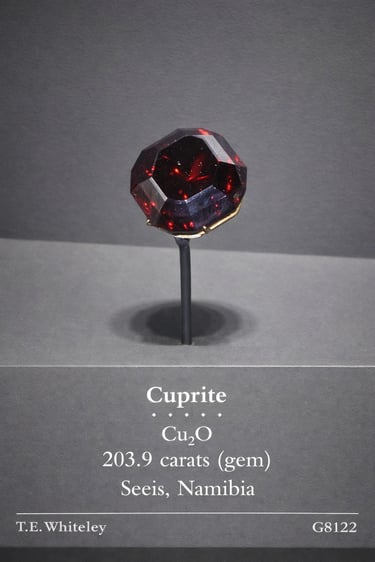
The Smithsonian Institution: Houses exceptional Namibian cuprites weighing 203.75, 172, 125.5, and 110 carats.
The Royal Ontario Museum: Possesses a stone weighing 66.34 carats.
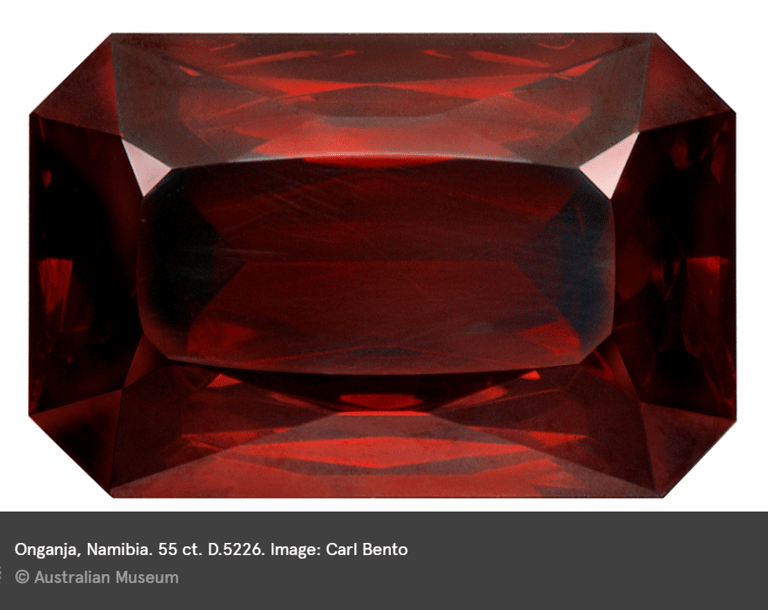
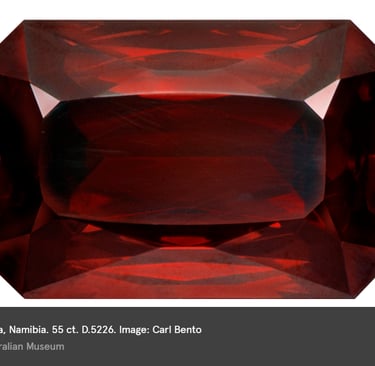
The Australian Museum: Holds a 55-carat faceted specimen.
A 52-carat stone effectively ranks among the top ten largest faceted cuprites in the world. This extreme scarcity indicates that such gems are cultural and scientific assets as much as they are commercial commodities.
The Role of Professional Certification
For collector gemstones of this magnitude, documentation from a recognized laboratory like the Gemological Institute of America (GIA) is essential.
Identification and Quality Verification
A GIA report confirms the stone as natural cuprite rather than a synthetic material or a visually similar mineral like garnet or spinel. The report details the "4 Cs"—color, cut, clarity, and carat weight—using standardized criteria for objective comparison.
Care and Curatorial Standards
Ownership of a large cuprite involves specific responsibilities due to the mineral's unique vulnerabilities:
Light Sensitivity: Prolonged exposure to sunlight can cause the vibrant red color to fade or dull over time. These gems are best stored in cool, dark environments.
Fragility: Due to its low hardness, any mechanical stress can result in fractures. Cleaning should be done with only lukewarm water and mild soap, avoiding ultrasonic cleaners and harsh chemicals.
Safety: While safe for skin contact, cuprite dust is toxic if inhaled or ingested due to its copper content.
Economic Valuation and Market Outlook
The market for cuprite is "thin," meaning transactions are infrequent and highly dependent on the stone's specific attributes. Standard faceted cuprites in small sizes may retail for $40 to $200 per carat. however, museum-grade specimens command significantly higher valuations.
Historical benchmarks include a 93.6-carat Namibian cuprite that realized $20,625 ($220 per carat) at auction in 2013. In the current market, a 52-carat custom-cut gem with exceptional clarity and "ruby fire" would likely be valued between $150 and $350 per carat, translating to a total value of $7,800 to $18,200.
As global demand for unique "collector gems" grows and new supply remains non-existent, the value of these circulating historical gems is expected to appreciate significantly as they transition into permanent private or museum collections.
Contact
Questions about The Red Hope™ pendant?
info@TheRedHope.com
© 2026. All rights reserved
The Red Hope™