History of The Hope Diamond
A Mineralogical Anomaly. A Legend Reimagined.
The Centerpiece: 52.23 Carats of Living Fire
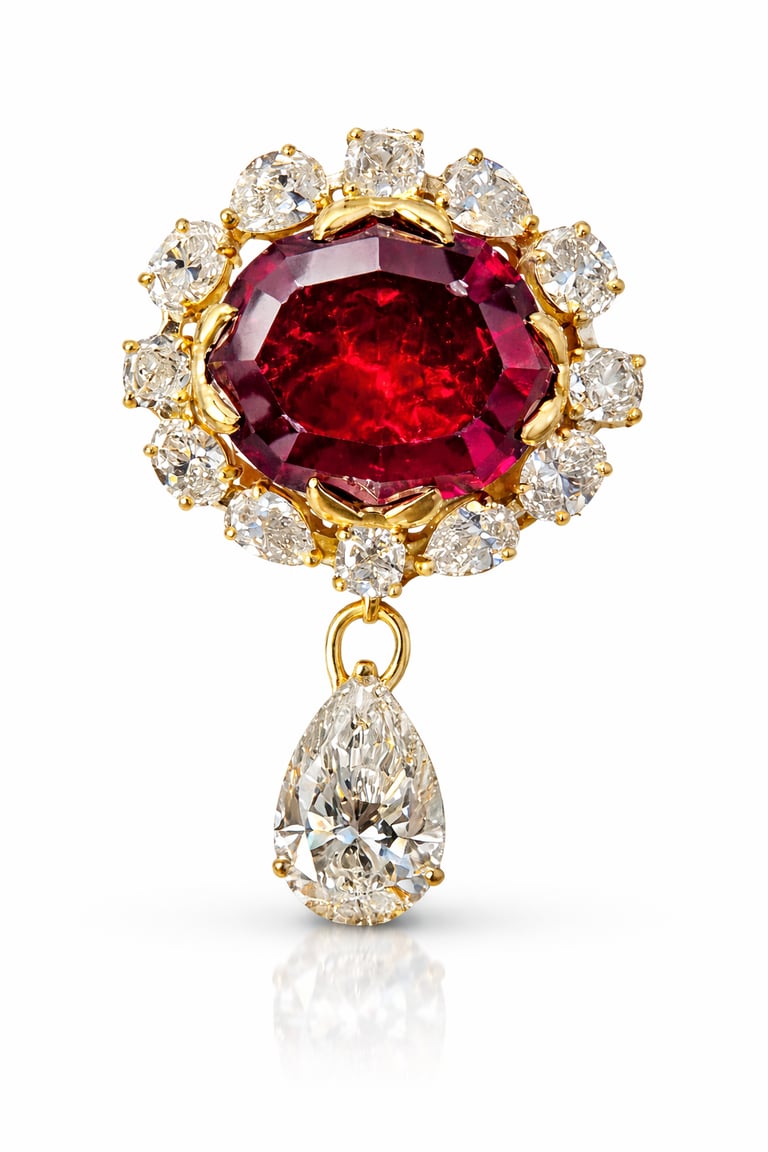
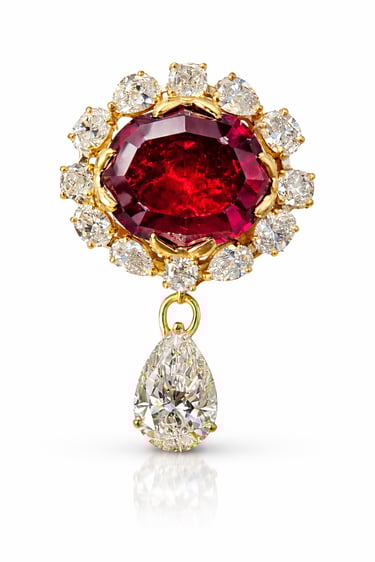
At the heart of this masterwork lies a 52.23-carat faceted Cuprite, a specimen that challenges the boundaries of gemology. Sourced from the now-silent Onganja Mine in Namibia, this stone is a remnant of a singular geological event that produced the only transparent, gem-quality Cuprite crystals in human history.
With a refractive index (2.85) that significantly exceeds that of a diamond, The Red Hope™ possesses a sub-metallic luster and an optical "fire" that is entirely unique. In ambient light, the stone appears as a deep, mysterious crimson-black; however, when moved, it reveals internal flashes of vivid pigeon-blood red—a signature of the finest Namibian material.
The Architecture: A Tribute to Iconography
The Red Hope™ was conceived as a conceptual counterpart to the world’s most famous jewel. Replicating the iconic silhouette and halo of the original Hope Diamond, this pendant translates that legendary blue legacy into the rarest red spectrum on Earth.
The "Cursed" Gold: The mounting is engineered in Custom 13-Karat Yellow Gold. This bespoke alloy was chosen specifically to honor the superstitions of the past, creating a metallurgical "talisman" that bridges scientific rarity with historical folklore.
The Halo: A precision-set brilliant diamond halo encircles the Cuprite, providing a stark, colorless contrast that amplifies the stone’s intense saturation.
The Weight of History: Due to the extreme density of Cuprite, the pendant possesses a remarkable physical "heft," making it as substantial in the hand as it is in the eye.
The Red Hope™ Story
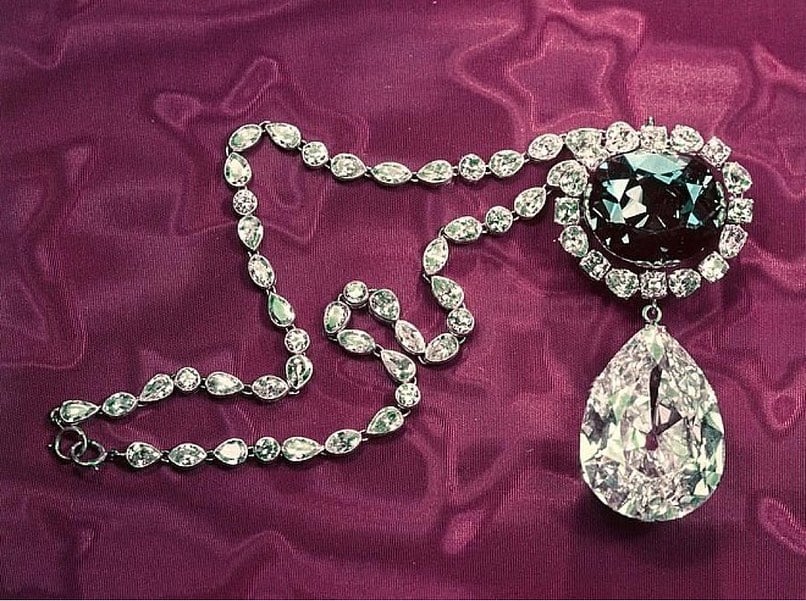
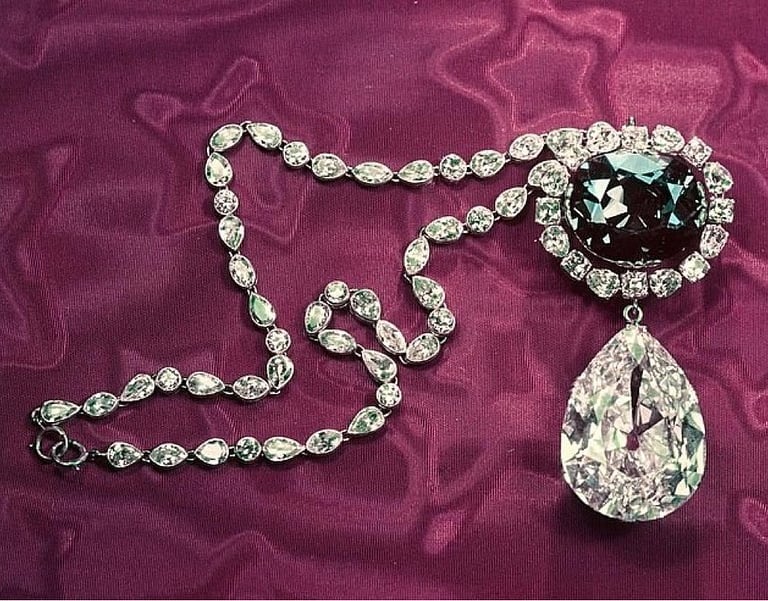
The Centerpiece: 45.52 Carats of Midnight Blue
At the heart of this legendary gem lies a 45.52-carat Type IIb diamond, a specimen that redefines the extremes of mineralogy. Sourced from the historic Kollur Mine in Golconda, India, this stone is a remnant of a rare geological phenomenon involving trace amounts of boron trapped within the carbon lattice.
With a refractive index (2.42) and a unique semiconducting nature, the Hope Diamond possesses a deep, grayish-blue hue that has captivated the world for centuries. In standard light, the stone radiates a sophisticated "fancy deep grayish-blue"; however, when exposed to short-wave ultraviolet light, it reveals a chilling secret: a vivid red phosphorescence that persists long after the light source is removed—a signature of its unique chemical impurities.
The Architecture:
The Hope Diamond is housed in its most famous setting, designed by Pierre Cartier in 1910. This arrangement was crafted to appeal to the socialite Evalyn Walsh McLean, translating a raw historical artifact into a masterpiece of wearable art.
The Setting: The mounting is engineered in Platinum, chosen for its strength and neutral luster. This metal serves as the elegant "anchor" for a stone steeped in folklore, bridging the gap between its origins in the French Crown Jewels and its reputation for bringing misfortune to its owners.
The Halo: A precision-set halo of 16 white diamonds—alternating between pear and cushion cuts—encircles the centerpiece. This brilliant contrast amplifies the stone’s somber blue depth, while the bale features an additional 45 diamonds to complete the necklace.
The Weight of History: Beyond its physical carats, the stone carries a remarkable "heft" of narrative. From its theft during the French Revolution to its eventual donation to the Smithsonian, its presence is as substantial in global culture as it is in the palm of a hand.
Contact
Questions about The Red Hope™ pendant?
info@TheRedHope.com
© 2026. All rights reserved
The Red Hope™